
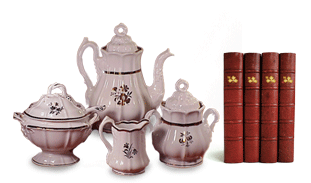
Round

Body Style: Banded Round

Biography

The Davis' utilized Clementson's popular Teaberry as the motif on their wares. The name of this very plain round shape, typical of the 1870's, is derived from the bands of the C-shaped handle of the teapot and repeated on the upturned handles of the sugar bowl.

A vanity box with the same banding was marked Livesley and Davis , evidently a transition piece made at the time the pottery was changing ownership. 

Naming Source: Club Named
Manufacturing Era: 1870s
Type of Company: Potter
Type of Ware: Bath, Dinnerware
Treatments: Copper Lustre
Footprints/Shapes: Oval, Round

Body Style: Fig Cousin

Biography

The addition of pink lustre makes this basic fig-leaved blank a very elaborate and showy body style. Note that the pink lustre detail even extends to the lids of children's pieces. Fig Cousin is one of the most prized of Tea Leaf body styles.

Naming Source: Club Named
Manufacturing Era: 1850s
Type of Company: Potter
Type of Ware: Bath, Dinnerware
Treatments: Copper Lustre with added Pink Lustre
Footprints/Shapes: Oval, Round
Potters:
Davenport
Hughes
Motifs:
Tea Leaf

Body Style: Columbia Shape

Biography

This Sydenham-related body style was potted by several makers, each adding their own individual touch by varying the finials. Livesley and Powell used a cone-shaped knob; Elsmore & Foster used an acorn on top of the child's pieces, and a nut finial on their adult pieces. Children's sets by Elsmore & Foster sport Morning Glory or Tpbacco Leaf motifs. Registered in 1855.

Naming Source: Factory Named
Manufacturing Era: 1850s
Type of Company: Potter
Type of Ware: Dinnerware
Treatments: Copper Lustre
Footprints/Shapes: Oval, Round

Body Style: Crystal Shape

Biography

Crystal is a very plain bulbous style potted by two famous producers of Tea Leaf ironstone. The only difference in the teapots is the rim style. Clementson used a flanged simple rim while Elsmore & Forster scalloped their flanged rim. Elsmore & Forster uses a heavily lustred knob finial.


Naming Source: Factory Named
Manufacturing Era: 1870s
Type of Company: Potter
Type of Ware: Bath, Dinnerware
Treatments: Copper Lustre
Footprints/Shapes: Oval, Round

Body Style: Grape Octagon

Biography

One of the most popular of the early body styles, Grape Octagon has fluted octagonal panels and grape embossing at handle terminals and finials. Pitchers and teapots have distinctive B-shaped handles.  

Naming Source: Club Named
Manufacturing Era: 1840s, 1850s
Type of Company: Potter
Type of Ware: Bath, Dinnerware
Treatments: Copper Lustre
Footprints/Shapes: Octagon (8-Sided), Round

Body Style: Cable Shape

Biography

One of the most popular and available bulbous body styles, it is said to have been potted to commemorate the laying of the Trans-Atlantic cable.

Naming Source: Factory Named
Manufacturing Era: 1870s, 1880s, 1890s, 20th Century
Type of Company: Potter
Type of Ware: Bath, Dinnerware
Treatments: Copper Lustre, Gold Lustre
Footprints/Shapes: Oblong, Other, Oval, Round

Body Style: Bamboo

Biography

A square style with handles and finials resembling bamboo stalks, this was one of the most widely produced body styles. Holloware pieces were available in straight-sided style as well as a slightly bulbous version. Bath set pieces such as ewers and master waste jars are often round and bulbous.

Registered in 1873.

Naming Source: Club Named
Manufacturing Era: 1880s
Type of Company: Potter
Type of Ware: Bath, Dinnerware
Treatments: Copper Lustre
Footprints/Shapes: Oblong, Round

Body Style: Chelsea

Biography

Fluted corners on an otherwise plain surface characterize this beautiful body style. Fancy finials and handles provide added embellishment to an otherwise simple form. When comparing the different manufacturers you will notice the following:


Alfred Meakin - Has a skewered finial and oval, round or oblong footprints. Butter pats do not have any noticeable ridging but are scalloped and can be confused with Simple Pear although the latter is always marked Alfred Meakin LTD.

Naming Source: Club Named
Manufacturing Era: 1880s
Type of Company: Potter
Type of Ware: Bath, Dinnerware
Treatments: Copper Lustre, Gold Lustre
Footprints/Shapes: Oblong, Oval, Round

Body Style: Blanket Stitch (Piecrust)

Biography

Embossed bands on holloware pieces resemble blanket hemstitching or piecrust rims, features sure to have appealed to the Victorian housewife.

Naming Source: Club Named
Manufacturing Era: 1880s, 1890s
Type of Company: Potter
Type of Ware: Bath, Dinnerware
Treatments: Copper Lustre
Footprints/Shapes: Oval, Round
Potters:
Alcock
Bridgwood
Motifs:
Tea Leaf

Body Style: Bow Knot

Biography

A bulbous body style with embossed bowtie-like designs at the handle terminals. This style has only been found in chamber/bath sets. The ewer is unique in that it does not have a true pouring spout.

Naming Source: Club Named
Manufacturing Era: 1890s
Type of Company: Potter
Type of Ware: Bath
Treatments: Copper Lustre, Gold Lustre
Footprints/Shapes: Round
Potters:
Wilkinson