
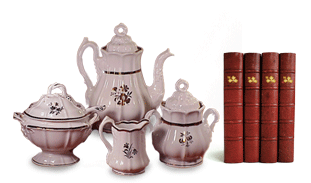
Body Style: Double Banded Loop
BiographyDouble bands surround the loops of this body.
Manufacturing Era: 1860s
Type of Company: Potter
Type of Ware: Dinnerware
Treatments: Copper Lustre
Footprints/Shapes: Round
Double bands surround the loops of this body.
Panache is a fitting name for a body style that is splashed with glittering copper lustre. The plates sport embossing with swirling copper lustred lines. The Beardmore & Dawson firm was only in business for four months. There were other Beardmore partnerships, but the B & D mark is very rare indeed.
Registered in 1863.
This body stryle uses copper lustre to highlight the stems and fruits in this stunning design. Jean Wtherbee attributed this body style to J. F. Barrow and Company.
Plain Round is a term we use to describe a variety of wares by different potters. These wares are typically of a simple bulbous shape, unadorned and may have been produced for institutions such as hotels or restaurants and Inns. Durability was the drawing card, yet there is beauty in the simplicity of the lines. They were not necessarily manufactured to go with one body style but with many different ones. Plain Round can be found in children's and adult wares, as well as in bath and dinnerware items.
This body style is nick named "Grape and Medallion." It was produced extensively in white ironstone by E & C Challinor. The plate rim features an embossed outer chain from which grape leaves are suspended.
Wilkinson's round body style is embellished with stylized hawthorn leaves at the handle and finial terminals. Because of the three-toed lustre treatment on the leaves, some collectors nicknamed this style "Claw."
Diamond Simplicity is a variation of the Simplicity body style. It features an embossed diamond prominently displayed on the handles and finials.
We know that Powell and Bishop decorated this shape with a Rose motif while Anthony Shaw used lustre bands. It is possible that other motifs will be found on this body style in the future.
Dangling Tulips is the nickname of a body style registered by Edward Pearson. A firm named Pearson, Farrall & Meakin operated a pottery in Shelton in 1854. The firm did not last very long for there is no record of a notice of dissolution for the partnership. Mr. Pearson and Mr Farrall evidently went their separate ways, both potting the same shape under their individual names. (The Meakin in this partnership was James Meakin, not one of the Tea Leaf Meakins.)
Elsmore & Forster's very popular wheat style was widely copied by other potters, both British and Amrican. It is an extremely well potted line which is found in many elegant decorations. In addition to the copper lustre enhanced version, there are examples with cobalt, a lighter blue, green and gold lustre, a mustard yellow and even in a Rockingham glaze.
Registered in 1859.
Many potters produced goods in the Gothic style, such as Classic Gothic, Full Panelled Gothic, etc. To our knowledge, only Elsmore and Forster actually marked their wares with the "Gothic Shape" name.
The mark has appeared on a relish dish that has also been found marked "Portland Shape."
Plain Tobacco Leaf plates have been found maked "Gothic Shape" also.